Marcel·la Barceló
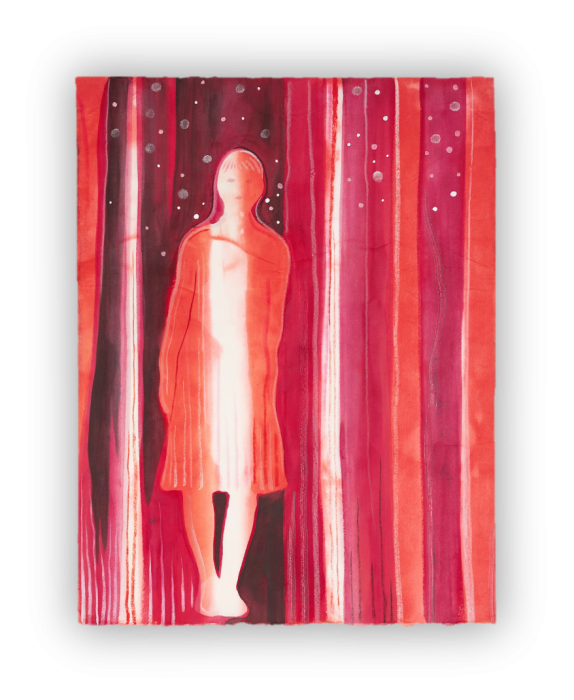
KodamaYear 2023
Medium Pigment print on Fine Art paper
Dimensions 42 x 32 cm.
Edition 25 + 3 AP
Influenced by her many trips to Japan, and especially by the teachings of Mono No Aware, Marcella Barceló’s work conveys an evanescent world through the representation of fleeting moments.
This impermanence as a connection to the world is derived from the Shintô philosophy, to which the artist feels very connected. According to Shintoism, unlike in Western cultures, man is not at the center of the world and nature, but part of a harmonic whole, with no desire to classify or dominate.
The investigation into a non-anthropocentric world order can be seen through the positioning of the human figures drawn by the artist. They don’t seem to have any sort of control over their environment, but rather dissolve into it, melting into the flow of the elements.
For Art-O-Rama, Marcella Barceló has collaborated with Chateau La Coste to produce two different kinds of edition, as both pigment and lithographic prints.
The three pigment printed editions, produced by the Marseille-based printing studio Tchikebe, were conceived from a series of drawings made during her last trip to Japan. Each title refers to the Yôkai, creatures from Japanese folklore: Kodama is the tree spirit, Betobetosan, a spectre easily recognisable by the sound of its footsteps and Zashiki Warashi, the domestic and beneficial spirit.
Additional works by Marcel·la Barceló are available
Your work is carefully packed and insured throughout transport.
Each work is a limited edition and sold unframed
Secure online credit card payment
Marcel·la Barceló (b. 1992, Palma de Mallorca, Spain) is a Catalan painter whose practice is shaped by a geographically and culturally plural trajectory, spanning the Balearic Islands, Paris, and Japan. This multiplicity informs a singular sensibility, where each landscape contributes to a visual and symbolic vocabulary rooted in an embodied experience of place. Her connection to the living world—particularly the sea and mountains of her insular childhood in Mallorca—constitutes a foundational dimension of her work.
Marcel·la adopts an intuitive, process-led approach, working without preparatory sketches. Her practice moves fluidly across materials—oil, acrylic, pencil, nail polish, and natural pigments— deployed in service of a tactile and immersive pictorial field.
Her compositions evoke environments of fluid instability: landscapes in perpetual transformation, animated by the sensation of metamorphosis. Water, a central and structuring element, transcends the role of motif to become a conceptual and spatial force. It shapes the mental architecture of the image, operating as a vehicle of change. Submerged islands, aquatic forests, and dreamlike reefs suggest immersion in a liquefied, amorphous space.
This mutable nature—charged with invisible energies—is mirrored in an organic, gestural language that seeks not to depict form but to evoke states of being. Within this floating world, spectral figures of young girls recur, reminiscent of the emblematic characters of Henry Darger or Marie Laurencin. Androgynous and diaphanous, these silhouettes inhabit a liminal zone—both present and dissolving, suspended in an ontological in-between. As anti-heroines within a non-linear narrative logic, they embody a state of identity-in-formation: fluid, provisional, and open-ended. Inspired by the spectral iconography of Japanese folklore—yūrei(¹) and ikiryō(²)—these apparitions retain a quiet agency: intermediaries or witnesses to an altered reality, their gaze oscillates between wonder and unease.
Barceló’s work engages myth and legend through the prism of the intimate, proposing a re-enchanted cosmogony animated by subterranean forces. Mutation and mystery converge in a vision of nature that is archaic, witch-like, and resistant to rational perception—revealing a fragile and elusive equilibrium of the living.
Rather than narrative sequences, her paintings function as rituals or mindscapes, where ancestral memory surfaces discreetly yet insistently. These spaces resonate with the poetry of Wallace Stevens and Barbara Grenfell Fairhead, the phenomenological poetics of Gaston Bachelard, and the mythic transformations of Ovid’s Metamorphoses. Her referential field moves between Félix Vallotton’s moon and sunsets, the existential intensity of Edvard Munch, and Lewis Carroll’s Wonderland, in a visual language where fragility and turbulence coexist and crystallize in iridescent surfaces.(³)
(¹) Spirit from Japanese folklore, the soul of a deceased person unable to find rest.
(²) Wandering spirit of a living person, from Japanese belief, separated from the body under the influence of intense emotions.
(³) “ It is by lingering long enough on iridescent surfaces that one comes to understand the value of depth.” — Water and Dreams, Gaston Bachelard, José Corti Editions, 1942, p. 16
Artists Marcel·la Barceló
Name of the work Kodama
Year 2023
Medium Pigment print on Fine Art paper
Edition 25 + 3 AP
Dimensions 42 x 32 cm.
Signed Yes
Numbered Yes
Certificate of authenticity No